
Monroe Records Open to the Public
The custodian matters more than the building. Monroe public records include council, permit, planning, code, and police administrative files. Union County keeps deeds, property assessments, voter data, and the current jail roster. The Clerk of Superior Court controls actual state court files filed in the county, while state agencies maintain correction, registry, and statewide certificate systems. Open access also varies by record. An online index may be free even when a certified copy requires identification, eligibility, or a fee.
| Monroe record set | Official keeper | Web route | Public access |
|---|---|---|---|
| Deeds and plats | Union Register of Deeds | Name-based Deed Look-up | Free index; office for broader land files |
| Civil, criminal, and estate cases | Union Clerk of Superior Court | eCourts Portal | Public case data; clerk supplies files and certified copies |
| Property assessment and maps | Tax Administration and GIS | Spatialest and UC Atlas | Free current roll and map-quality data |
| Birth, death, and marriage certificates | Register of Deeds or N.C. Vital Records | Ordering systems, not a full name index | Uncertified copies available; certified copies restricted |
| Voter registration | NCSBE and Union Board of Elections | State lookup and weekly data | Public fields only; protected details withheld |
| Jail and correction records | Union Sheriff and NCDAC | County roster and state search | Selected booking and correction data |
Some files are closed or partly redacted. Sealed and expunged cases, juvenile matters, adoption files, protected mental-health proceedings, confidential voter fields, and restricted motor-vehicle information are not made open merely because another record mentions the same person. Military discharge records also have special access rules. If open and confidential facts share one file, the requester may ask for the public portion with protected facts removed.
Chapter 132 Rules for Monroe Records
North Carolina Public Records Law begins with records made or received in public business. Under G.S. 132-6, any person may inspect records at reasonable times under reasonable supervision and obtain copies as promptly as possible. There is no single deadline measured in a fixed number of days. The custodian cannot demand a purpose or motive, but the request must describe an existing record well enough to locate it. An office need not answer a research question, create a new report, or work outside normal hours.
Uncertified copy charges may not exceed the actual direct cost of reproduction under G.S. 132-6.2. A special service charge can apply to a request that consumes extensive technology, clerical, or supervisory work. The office must explain a denial on legal grounds and put that reason in writing when asked. Database requests may need to be written. Online viewing or downloading can satisfy the copy duty, yet certification may carry a separate fee set by another law.
- Custodian
- The office or official responsible for the requested government record.
- Index
- A searchable list of names, dates, or document references. It is not always the record image.
- Certified copy
- An official copy authenticated by the keeper for formal use.
- Exemption
- A law that closes a record or specific fields that would otherwise fall within access rules.
Monroe Deed Records Have Limits
The Union County Register of Deeds land-record page describes a much narrower web tool than the phrase “official records search” might suggest. Its Deed Look-up covers deeds and plats, searches by name rather than street address, and does not include mortgages. The county does not publish the online index’s starting year. That missing date must not be replaced with Union County’s founding year.
A name search can point to a deed or plat reference, but it may not provide an image or certified copy. Mortgages, homeowners-association covenants, conditions, and restrictions require an office search. Liens and judgments belong with the Clerk of Superior Court. For deeds and general instruments, the published recording charge is $26 through 15 pages, then $4 for each extra page. Recording costs are not the same as copy costs, and the current land-copy charge should be confirmed with the office before ordering.
Grantor means the person conveying an interest, while grantee means the person receiving it. When an address is the starting fact, first use the tax property portal to learn the owner’s exact spelling and parcel number. Then take that name to the deed index. This keeps an address-only search from failing at a tool that was built around names.
Note: The Register of Deeds counter is the required fallback for mortgages and association covenants not available through the narrow online lookup.
Monroe Court Records Changed in 2024
Union County joined statewide eCourts on October 14, 2024. The free eCourts Portal now provides the first web check for current Union County civil, criminal, estate, special-proceeding, divorce, judgment, and foreclosure matters that are public. Search results are informational. The Union County Clerk of Superior Court remains the keeper of the actual case file and the source for certified documents.
| Portal control | Input | How it narrows a Monroe search |
|---|---|---|
| Smart Search | Party name or case number | Starts the public case query |
| Search Type | Party, business, citation, case number, and other modes | Matches the known fact to the right index |
| Location | Court dropdown | Limits results to Union County |
| Date of Birth | Date criterion | Helps distinguish people with similar names |
| Case Type and Status | Dropdown filters | Separates active, closed, and subject areas |
| Filing Date | Date range | Focuses the result period |
A docket is the court’s running case record. Public results may show the case number, parties and roles, status, filing and index dates, events, hearings, assignments, dispositions, and some financial data. They do not open sealed, expunged, juvenile, or other restricted material. Anonymous access is free. Creating an account adds saved-case tools but does not grant broader public rights.
Monroe Records Beyond the Web
The idea that eCourts moved every case record onto the web is false. A courthouse self-service terminal can search criminal cases by defendant, case number, victim, or witness. Civil, estate, and special-proceeding systems can search by party or file number. The civil terminal accepts partial names in “Last Name, First Name” form. Paper files are inspected with the clerk in the county where the case was filed, and a divorce judgment comes from the clerk in the county that granted it.
This counter route is especially useful for older files, uncertain spellings, and records whose complete document is not shown online. The county-specific AOC-CR-314 form requests a certified criminal search for $25. North Carolina court officials do not issue a certified statewide criminal search. A noncertified terminal search is free apart from printing, while copies of the case file carry a fee.
Insider tip. Bring every known name variant, the approximate filing period, and any case or file number. The clerk’s terminal supports fields that a simple web query may miss.
Note: A June 2025 kiosk rollout added scanners, printers, and payment functions at the Union County courthouse, but the clerk still controls case files.
Monroe Property Records and GIS
The Union County property search accepts an owner name, street address, or parcel ID. A parcel card can show the owner, physical or situs address, mailing address, market value, parcel number, legal description, land and building values, acreage, use, neighborhood, township, and tax district. Situs means the physical location of the parcel. The mailing address is where tax correspondence goes, so it must not be treated as proof that the owner lives at the property.
County maps add geography to the assessment roll. The Union County GIS hub routes users to parcel mapping, and UC Atlas supports owner, parcel, address, subdivision, street, acreage, and sales searches. It offers aerials from 2019, 2021, 2023, and 2025, along with print and selected-feature export tools. The county warns that GIS is tax-purpose, map-quality data, not a survey or legal parcel description. Recorded deeds and surveys come from the Register of Deeds.
The official Union County GIS choices appear in the captured interface.
The hub helps select a mapping tool, while the tax card remains the better source for assessed ownership fields. Monroe advises that county zoning layers can lag city amendments, so current zoning must be checked with city Planning.
Monroe Vital Records Access
Birth, death, and marriage events in Union County are handled by the Register of Deeds, with statewide services through N.C. Vital Records. There is no verified complete official public name index for these local certificates. Under G.S. 130A-93, certified birth and death copies are limited to authorized people such as the registrant, spouse, certain close relatives, or a qualified agent or legal representative. Anyone may seek an uncertified copy through the county process, subject to redaction of confidential identifiers.
Union County lists $10 for a certified county birth, death, or marriage certificate and $1 for an uncertified copy. An in-person applicant for a certified copy must present an accepted current government ID. Requests may also be mailed to the Register of Deeds or placed through the online ordering route. The county lists cash, money order, and credit card payment, with a card surcharge. Divorce has two custodians: the Union clerk keeps the judgment and case file, while state Vital Records keeps a certificate or abstract.
The North Carolina vital-record ordering page displays the available certificate request methods.
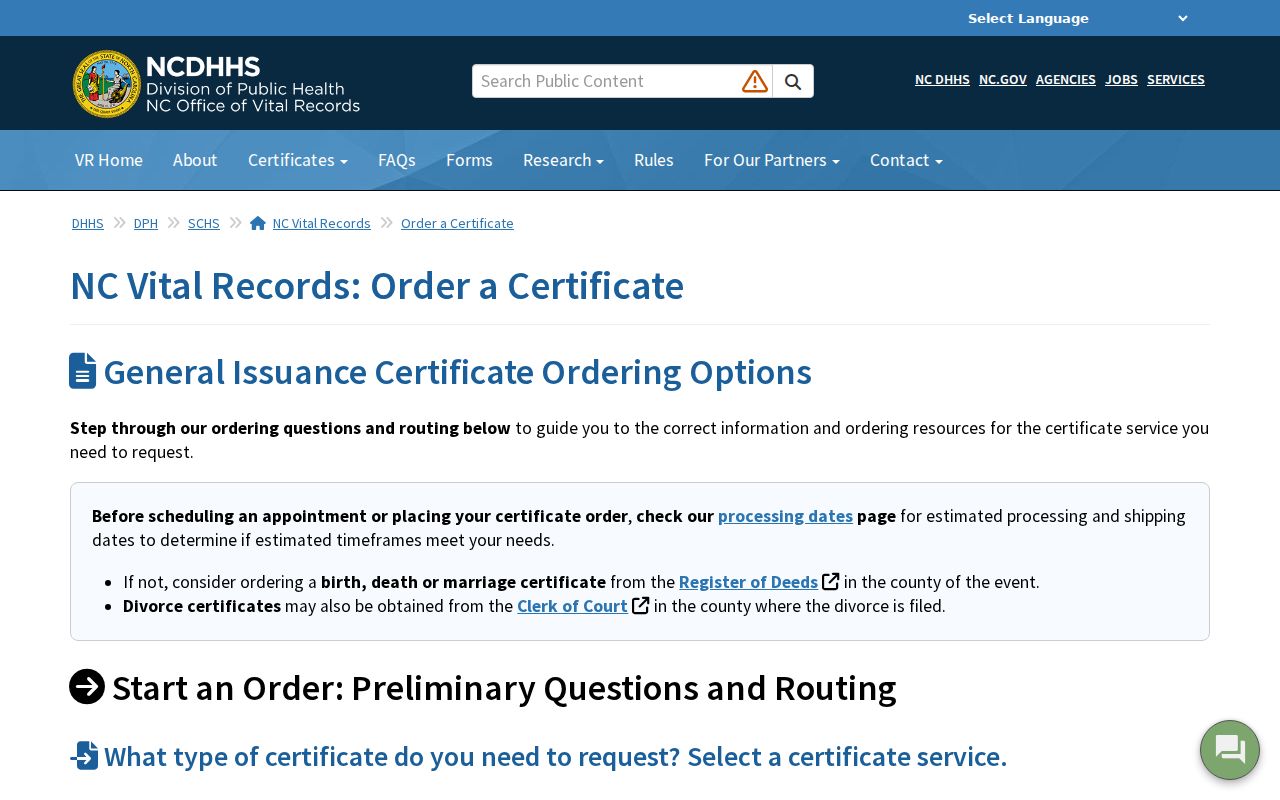
The order route does not turn sealed adoption records into open files. No official source reviewed supports a simple fixed age when Union County birth or death certificates become fully open for genealogy.
Monroe Custody and Registry Records
The Union County Sheriff inmate inquiry searches the current county roster by first and last name. Results can show a name, race, sex, age, primary charge, arrest date, booking agency, and a detail or image link. A booking is an allegation and custody event, not a conviction. The archive span and the full set of bond and release fields are not published, so historical questions should go to the Sheriff or jail desk.
State prison, probation, and parole information uses the N.C. Department of Adult Correction search, whose public coverage reaches 1972. It is separate from the county jail. The N.C. Sex Offender and Public Protection Registry offers official name and address-based searching. These tools publish only selected fields, and many internal correction files remain confidential under state law.
The official North Carolina offender registry shows its public search entry points.
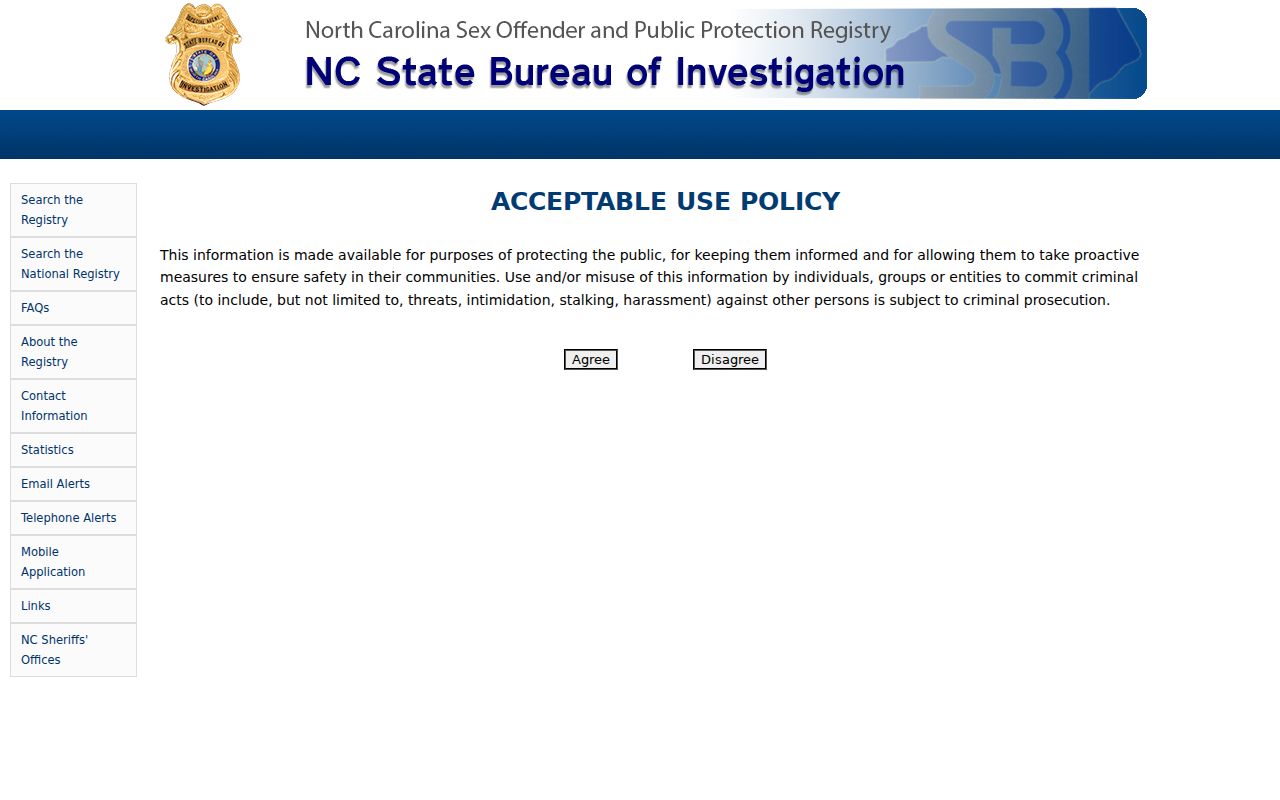
The registry’s own warnings and use limits matter. Public availability never authorizes threats, stalking, impersonation, or harassment.
Monroe Public Records Offices
Monroe’s county-seat role puts several counters within the city, but it does not merge their authority. Use City Hall for municipal business, the Government Center for recorded land and county administrative material, and the Judicial Center for state court files. Calling before a visit is wise when the request involves an older volume, a certified copy, or a restricted category.
Union Register of Deeds
500 N. Main Street, Suite 239
Monroe, NC 28112
704-283-3843
Recording hours: weekdays, 8 a.m.–5 p.m.
Union Clerk of Superior Court
Union County Judicial Center
Monroe, NC
704-698-3100
Court, estate, judgment, divorce, and foreclosure files
Monroe City Hall
300 W. Crowell Street
Monroe, NC 28112
704-282-4500
City Clerk: 704-282-4502
Union Tax Administration
500 N. Main Street
Monroe, NC 28112
704-283-3746
Owner roll, parcel assessment, and tax records
Monroe City and County Requests
Municipal requests for council records, ordinances, contracts, planning and annexation files, permits, code material, and releasable police administrative records belong in Monroe’s request system. The city says requests are handled first-come and are typically fulfilled within four weeks. That is a service estimate, not a statutory Chapter 132 deadline. The Monroe NextRequest portal is the web route. For a web failure, contact the City Clerk at 704-282-4502 or use City Hall at 300 W. Crowell Street. Police record requests can be directed to the Police Records Division at 450 W. Crowell Street, 704-282-4728, with the report number, date, location, and involved names when known. County administrative material uses a different portal, and neither route should receive a Union County court case-file request.
Union County uses its own NextRequest system. The first four collective staff hours carry no special service charge. After that, the county charges $40 per hour plus copying, provides an estimate or not-to-exceed amount, and may require prepayment. Same-subject requests from one requester within five business days are combined for this calculation.
The Union County request portal also displays published request activity.
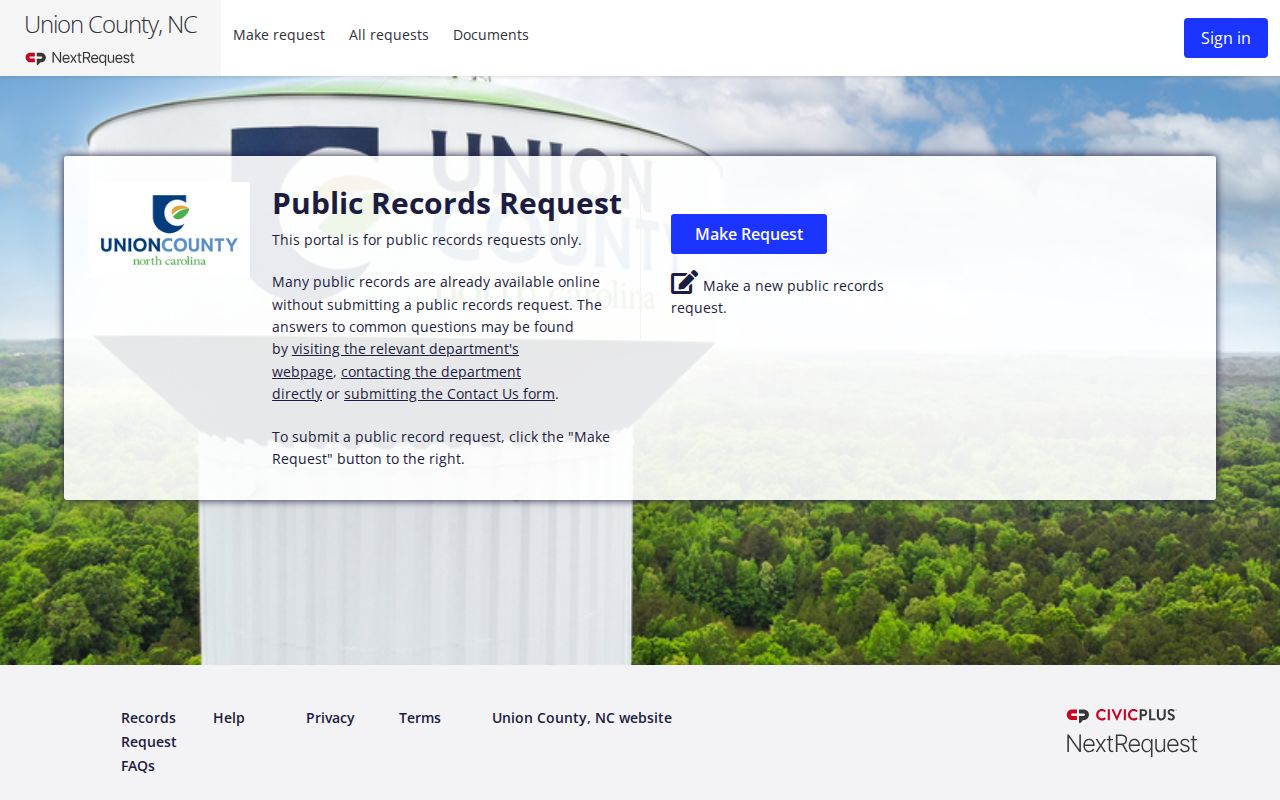
The county portal is for existing county administrative files. Deeds, court cases, and state-held files still follow their dedicated custodians and counter or mail procedures.
Monroe Judicial Records Requests
The N.C. Administrative Office of the Courts request form is only for existing Judicial Branch administrative records. It does not obtain a Monroe case file, case information, birth certificate, or marriage certificate. The form asks for the requester’s name, organization title when applicable, phone, email, mailing address, and a description of the desired records. Inspection is free, and the published copy rate is 25 cents per page, with extraordinary service charges possible.
Use the electronic form or mail a request to Public Records Request, P.O. Box 2448, Raleigh, NC 27602. A denial may be appealed to the NCAOC Public Records Officer. The published pre-litigation mediation path uses form AOC-CV-830 filed with the local clerk; it cannot be e-filed and a filing fee applies. Actual Union County court documents, by contrast, must be requested from the local clerk by party name, case number, and filing details.
The Judicial Branch administrative-record form makes the requester and record-description sections visible.
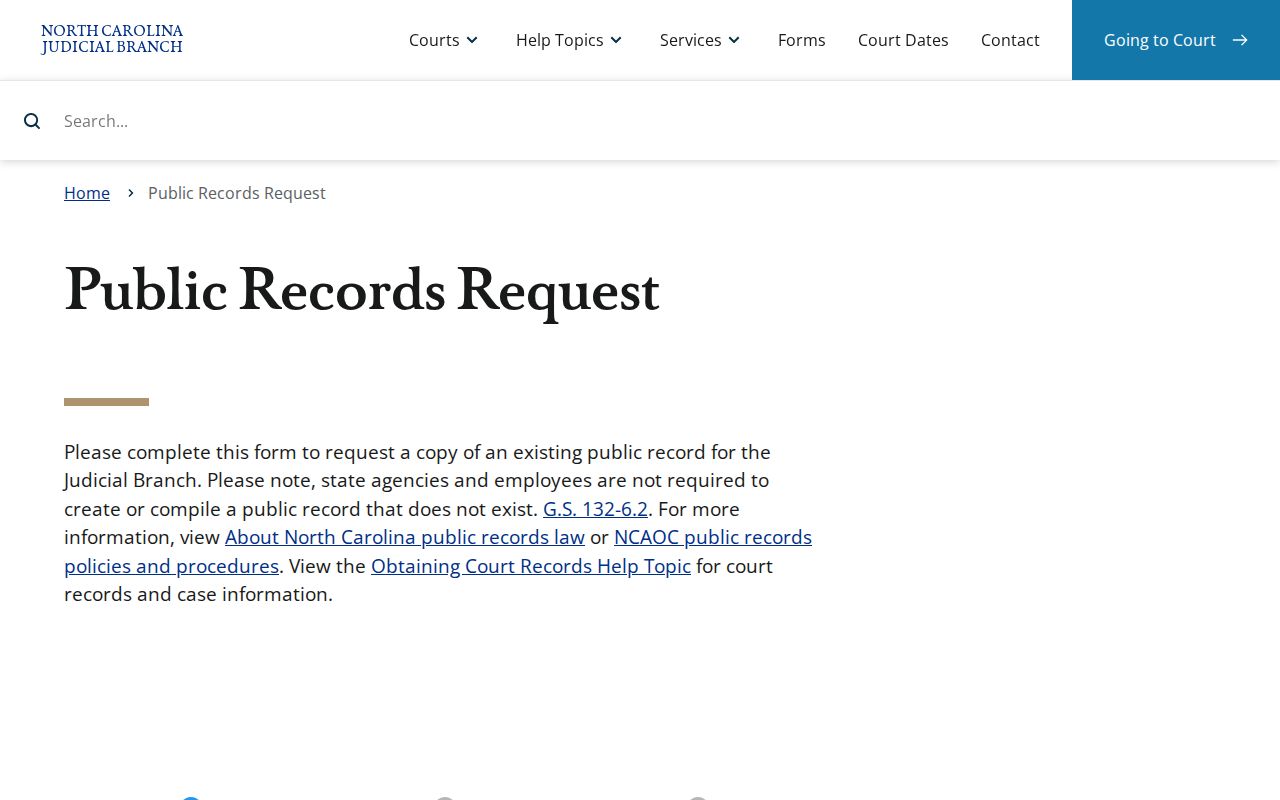
The form’s design reinforces the routing rule: administrative material goes to NCAOC, while the Union County clerk handles the underlying local case file.
Request Monroe Public Records
A focused request for Monroe public records moves faster and makes fee review easier. Start with the office that created or keeps the file, then distinguish inspection from a plain or certified copy. Use the dedicated web index where it can identify the exact record, but keep the counter, phone, mail, and formal request routes ready when the portal is incomplete or unavailable.
- Name the existing record. Give the record type, subject or party, date range, address, parcel ID, book and page, case number, or report number that the custodian can use.
- Choose the correct keeper. Send city business to Monroe, county administration to Union County, deeds to the Register, and case documents to the Union clerk.
- Select the access channel. Search online first when an index exists. Otherwise ask for counter inspection, call for current procedure, or send the office’s form by portal or mail.
- Ask for useful format and cost. Request native electronic form when practical, choose inspection to avoid copy expense, and obtain an estimate before broad work begins.
- Handle protected material narrowly. Ask the keeper to redact confidential fields and release the rest rather than assuming the whole file is closed.
- Get a written denial. Request the statutory reason. Narrow an unclear request, use the agency appeal path where offered, or consider the remedies available under Chapter 132.
Lawful personal use. Open access supports family research, estate work, fraud checks, and civic review. It does not permit stalking, threats, impersonation, or harassment.
Voter files have their own public and confidential fields. The complete lookup and protection rules are covered in the Monroe voter registration resource. Every other request should end with verification from the custodian, especially when an index entry differs from the underlying document.