
Search Monroe Voter Registration
The official N.C. State Board of Elections Voter Search is the first stop for a current Monroe voter lookup. Enter the registered first and last name, then use Union County to narrow common names. A birth year can separate people who share a name. Keep both status boxes in mind: the tool can search registered voters as well as removed or denied records.
| Lookup control | Input | Required | How to use it |
|---|---|---|---|
| First Name | Text | Yes | Use the registered legal first name |
| Middle Initial | Text | No | Enter one initial when it helps separate matches |
| Last Name | Text | Yes | Try prior or compound surname forms if needed |
| Year of Birth | Dropdown | No | Narrows results without exposing a full birth date |
| County | Dropdown | No | Select Union for a Monroe-focused result set |
| Voter Status | Checkboxes | One or more | Registered; Removed or Denied |
A missed match does not prove that a person never registered. Repeat the search without the middle initial, test a former surname, check a prior North Carolina county, and include removed or denied status. If that still fails, contact the Union County Board of Elections. The local custodian can explain a status or help frame a record request, while the state search remains the best route for a quick individual check.
The official lookup screen shows the small set of name and county controls used for this search.
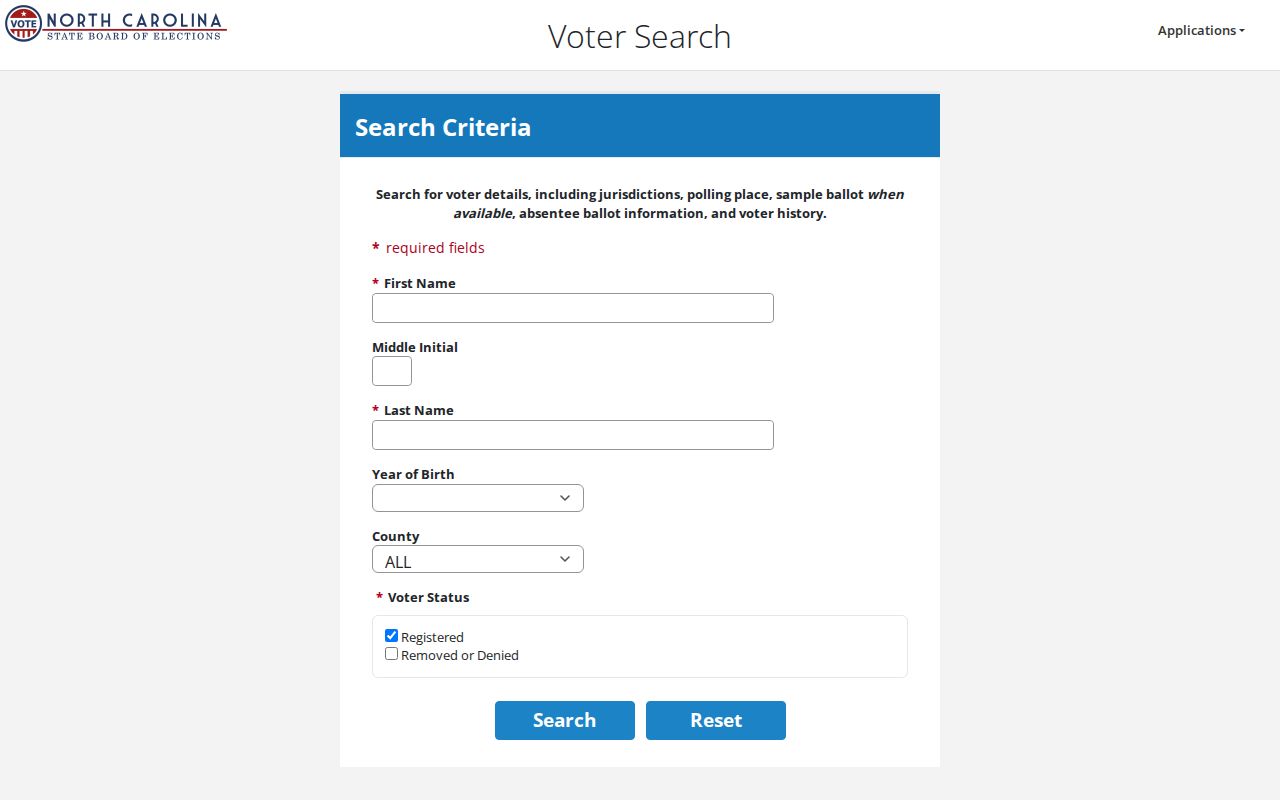
Its focused form helps avoid treating the statewide voter roll as an open-ended name browser.
Fields in Monroe Voter Records
A successful match can show far more than a yes-or-no registration answer. The public record links a voter to election jurisdictions and gives context for where that voter participates. The exact display can vary with the election cycle, but North Carolina’s published file layout documents the core data behind the system.
| Identity | Name, suffix, voter registration number, and NCID |
|---|---|
| Registration | Status, status reason, registration date, county, party, precinct, and municipality |
| Address | Residence and mailing fields unless a lawful protection suppresses residence |
| Demographics | Race, ethnicity, gender or sex, birth year, age at year-end, and birth state |
| Districts | Congressional, legislative, judicial, county, township, school, fire, water, and other districts |
| Election details | Polling place, sample ballot when available, absentee information, and participation history |
Several codes matter when reading the inventory. “A” means active, “I” inactive, “R” removed, “D” denied, and “S” temporary military or overseas. A mailing address may differ from the registration residence. The districts identify the contests and local units tied to the registration, not places where the person necessarily owns property.
North Carolina Voter Privacy
North Carolina draws a precise line between open voter data and fields kept outside public inspection. G.S. 163-82.10 controls that split. Full or partial Social Security numbers, the full date of birth, registration-agency identity, email address, driver-license number, voter-ID photographs, and ID copies are confidential. A signature may be viewed, but it may not be copied or traced.
Confidential by statute. The file may carry yes-or-no flags for identifying evidence, but it never publishes the actual license or Social Security number. Full birth dates and protected residences also stay out.
The February 2026 layout added clear flags for whether identifying evidence was supplied and whether HAVA identification is required. Those indicators describe administrative status only. A masked name marker or masked registration date can signal a review condition described in the state layout, so do not try to infer a hidden value from it.
Note: Ask for a redacted public record when a file mixes open voter information with a field that the statute protects.
Monroe Voting History Myth
Participation history is often misunderstood. It identifies elections in which a person participated, plus details such as voting method, precinct at that election, and party-primary context where applicable. It never reveals a candidate choice or any mark on the secret ballot. That limit holds for the individual lookup and the downloadable voter-history files.
Individual history reaches elections in the past ten years. The weekly history data uses NCID or registration number to connect a history row to the registration file, because the history file itself omits names and demographic fields. For a past Union County election, the state recommends using statewide history and filtering the voted-county description. A county file instead follows people currently registered in that county, which can miss a voter who moved afterward.
Ballot secrecy remains intact. A Monroe voter record can prove that someone took part in an election. It cannot show how that person voted.
Monroe Voter Records Custodian
The Union County Board of Elections is the local custodian for Monroe voter records. Its office is at 316-B E. Windsor Street, Monroe, NC 28112. Mail goes to P.O. Box 1106, Monroe, NC 28111-1106. Call 704-283-3809 or email union.boe@unioncountync.gov when a lookup needs explanation, a tailored county or precinct list is required, or a record needs local review.
The county’s information-request form asks for the requester’s first and last name, email, phone number, and a description of the information wanted. State law permits any person to request county or precinct lists selected by reasonable categories such as party, gender, race, registration date, precinct, district, or participation history. The list may not include a date of birth, though age-derived lists are allowed.
- Describe the county, precinct, date range, selection category, and desired file format.
- Submit the local online form, or contact the office by email, phone, mail, or at the Monroe counter.
- Confirm the scope with election staff if the request calls for a custom selection rather than a standard state download.
No fee or processing time is posted on the local form. Do not assume one. For broader North Carolina access-law context, use the Monroe public records request resource.
Download North Carolina Voter Rolls
The state’s voter data center provides free current statewide and county ZIP downloads. No ordinary application, account, eligibility statement, or purchase fee is required. Files update on Sunday evenings. They include current, former, attempted, and incomplete registrations, while older removed voters drop out when the most recent last-voted date is more than ten years old.
| Route | Best use | Cost and format | Fallback |
|---|---|---|---|
| State current file | Bulk statewide or Union County voter roll | Free ZIP; tab-delimited data | Use the published layout to read codes |
| Historical snapshots | Compare registrations across 15+ years | Free state downloads | Ask NCSBE about a missing snapshot |
| Voter history data | Study participation and method | Free weekly files | Join by NCID or registration number |
| County request | Reasonable local selection or staff help | Fee not stated; specify format | Phone, email, mail, or counter |
The state voter-data screen gathers current downloads, prior snapshots, and the data layout in one official place.
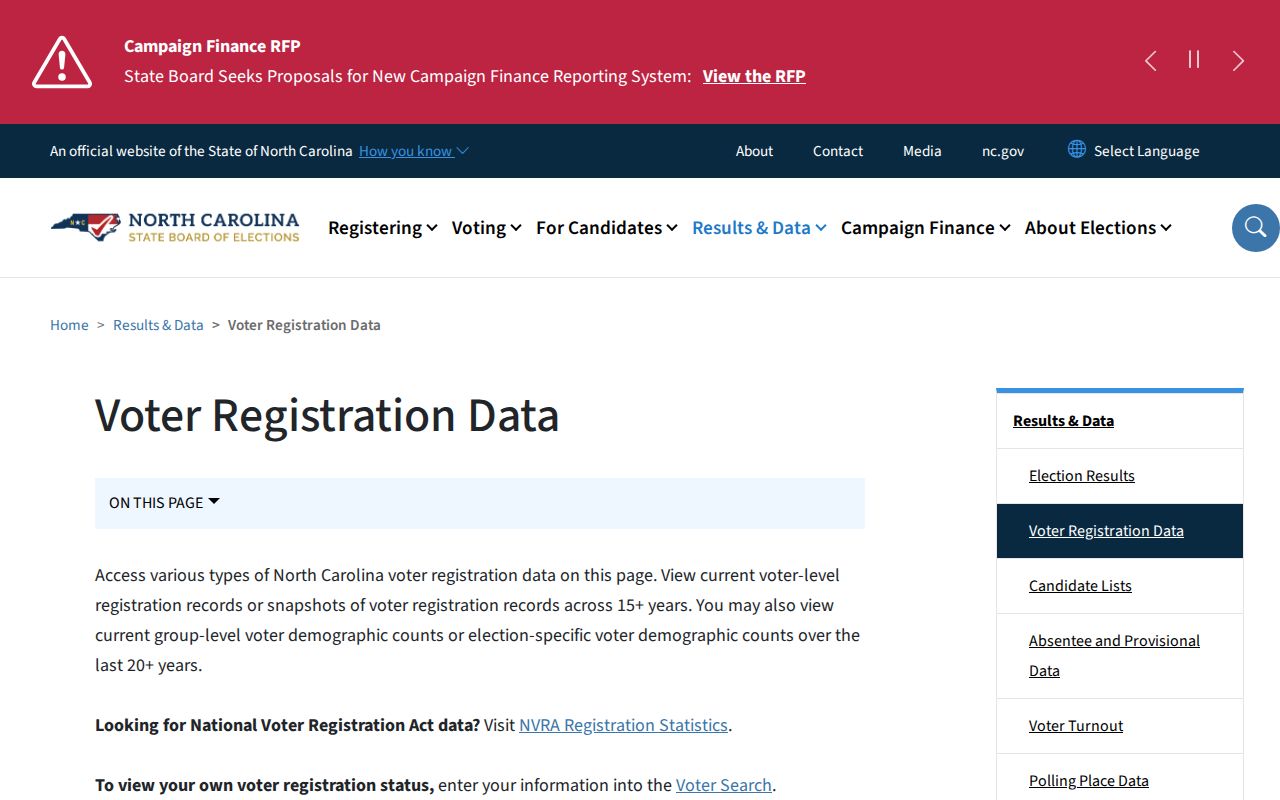
This route is meant for data work, while the individual Voter Search is faster for one known person.
Monroe Voter Status Changes
Inactive, removed, and denied are distinct states. North Carolina carries out continuous, uniform list maintenance with all 100 county boards under G.S. 163-82.14 and state guidance. Union County says that within two business days of registration it checks driver-license or Social Security evidence, checks for duplicates in the statewide database, updates the record, and mails address verification.
An inactive record is not the same as a cancelled registration. Removed records can still appear when the lookup’s removed-or-denied box is selected. When a current search fails, retry the registered spelling and former county before drawing a conclusion. Election staff can explain the status-reason code, but public files still will not disclose the confidential identity numbers used in the verification process.
Note: Save the status description and reason code together, since the one-letter status alone may not explain what happened to a record.
Protected Monroe Voter Addresses
Residence is usually public in North Carolina voter records, but safety protections can suppress it. A qualifying court or protective order can support suppression. A participant in the North Carolina Address Confidentiality Program may also present a current Chapter 15C card and signed safety statement to keep the actual residence out of the public record.
The Attorney General administers the Address Confidentiality Program for qualifying survivors of domestic violence, sexual assault, stalking, or human trafficking. It supplies a substitute address and mail forwarding. Enrollment uses a trained application assistant and requires the participant to have moved or be moving. Even when residence is suppressed, the voter’s name, precinct, and other lawful registration data remain public. The actual address stays available only for election administration, law enforcement, and court-authorized use.
Historic Union County Voter Records
The live lookup is not the end of Monroe election research. The State Archives confirms Union County election records for 1844, 1850, and 1858 in its miscellaneous holdings. Those early materials sit in a county created in 1842, when Monroe was laid out around the courthouse square. They can place a name in civic life long before the modern statewide database existed.
No complete official run of Union County poll books or registration registers was verified. Start with the State Archives county inventory, then ask the Union County Board of Elections about retained local material. The Dickerson Genealogy and Local History Room at Monroe Library can help bridge an old voter name to newspapers, city directories, family histories, and obituary files. That archive and library route is essential when the online roll reaches no farther.
Public access still demands lawful use. Never use a voter address or list to stalk, threaten, impersonate, or harass someone. Verify an unexpected demand or solicitation through the published Board of Elections number, and treat ballot-choice claims as false because the records cannot support them.